

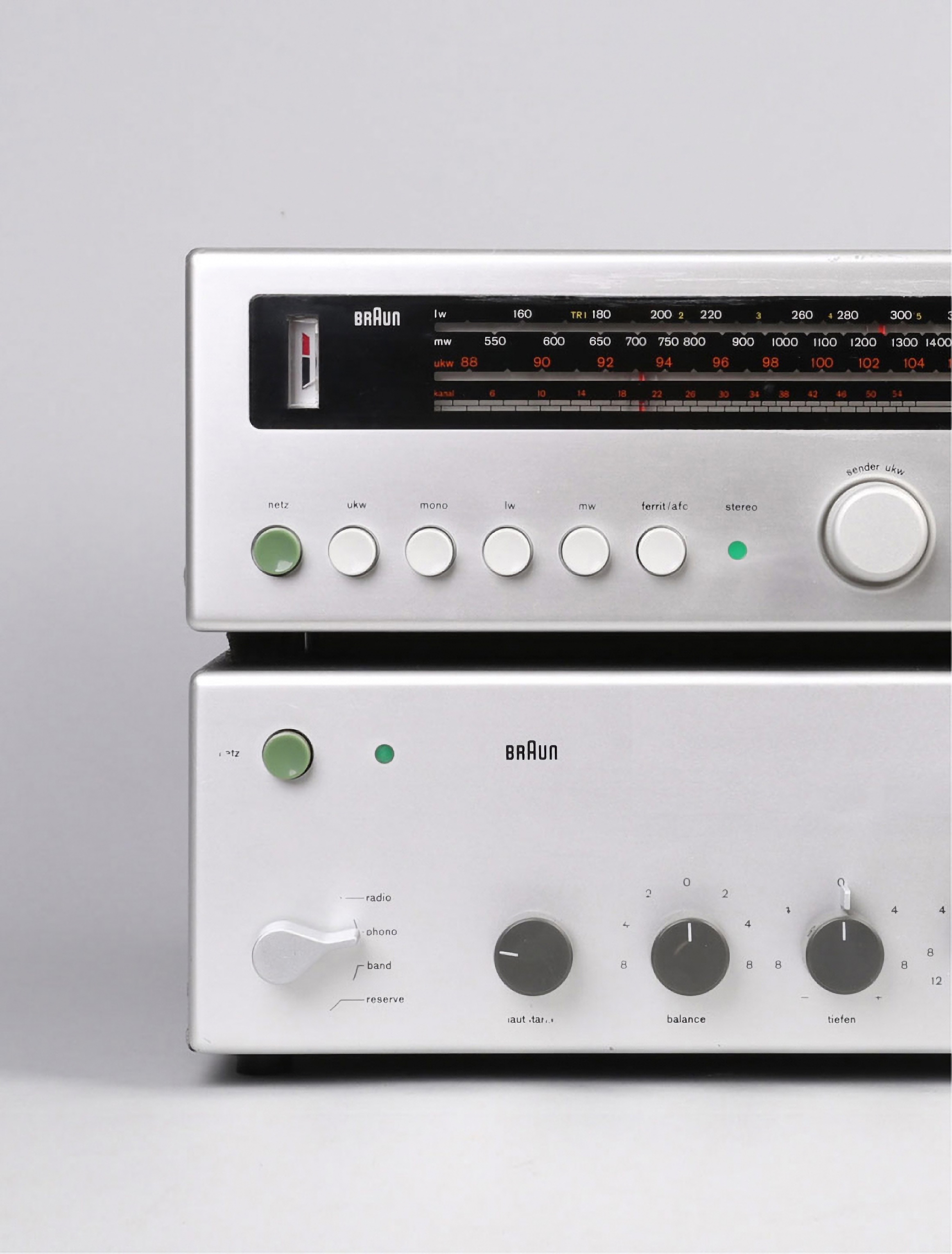
Dieter Rams defined German minimalist product design at Braun between 1959 and 1998, but his work didn't enter our modern vernacular until Steve Jobs, Jony Ive, and others embodied Dieter Rams' principles in Apple products.
Rams' ten principles have been discussed again and again in design circles, and it is equally important to recognize what each principle represents and what it misses.
Dieter Rams is an industrial designer, and not surprisingly, each principle gives us a metric to measure the quality of a product. Ram's principles say nothing about the design process.
In the late 1970s, Dieter Rams was becoming increasingly concerned by the state of the world around him: “An impenetrable confusion of forms, colours, and noises.”
Aware that he was a significant contributor to that world, he asked himself an important question: Is my design good design?
His answer is expressed in his ten principles for good design.
The possibilities for innovation are not, by any means, exhausted. Technological development is always offering new opportunities for innovative design. But innovative design always develops in tandem with innovative technology, and can never be an end in itself.
A product is bought to be used. It has to satisfy certain criteria, not only functional, but also psychological and aesthetic. Good design emphasizes the usefulness of a product whilst disregarding anything that could possibly detract from it.
The aesthetic quality of a product is integral to its usefulness because products we use every day affect our person and our well-being. But only well-executed objects can be beautiful.
It clarifies the product’s structure. Better still, it can make the product talk. At best, it is self-explanatory.
Products fulfilling a purpose are like tools. They are neither decorative objects nor works of art. Their design should therefore be both neutral and restrained, to leave room for the user’s self-expression.
It does not make a product more innovative, powerful or valuable than it really is. It does not attempt to manipulate the consumer with promises that cannot be kept.
It avoids being fashionable and therefore never appears antiquated. Unlike fashionable design, it lasts many years – even in today’s throwaway society.
Nothing must be arbitrary or left to chance. Care and accuracy in the design process show respect towards the user.
Design makes an important contribution to the preservation of the environment. It conserves resources and minimizes physical and visual pollution throughout the lifecycle of the product.
Less, but better – because it concentrates on the essential aspects, and the products are not burdened with non-essentials.
Back to purity, back to simplicity.
These principles can be shared accurately and fairly under the Creative Commons CC-BY-NC-ND 4.0 licence.